The 7 Best Email Ticketing Systems for Customer Support


If your team is having a hard time managing emails — losing track of requests and sending duplicate (and sometimes conflicting) replies — it's time to upgrade to an email ticketing system. Email ticketing systems help you collaborate effectively, keep track of requests easily, and answer customer emails faster.
But with so many options on the market to choose from, it can be hard to know what will work best for your team. To help, we've compiled this list of the seven best email ticketing systems. Below, you'll find our detailed reviews that cover which types of teams each option is best for, what unique features they offer, and how they compare on price.
At Help Scout, we only publish deeply researched, human-written content. If you find our content to be as helpful as we strive to make it be, you can set us as a preferred source in Google so you'll see our content surfaced more often when you're searching.
| Platform | Summary | G2 Rating | Free Trial | Starting Price |
|---|---|---|---|---|
Help Scout | Best for relationship-driven businesses, Help Scout is designed to help you manage high volumes of email requests without sacrificing the quality of your responses. | 15 days | Free plan available; paid plans start at $25/user per month | |
Gmelius | Best for managing support requests in Gmail, Gmelius lets you create shared inboxes in Gmail and access features like assignments, SLAs, email templates, and reports. | 7 days | $25/user per month | |
Emailgistics | Best for managing support requests in Outlook, Emailgistics lets you create shared inboxes in Outlook and access features like SLAs, reports, and assignments. | 14 days | $11/user per month | |
Hiver | Best for teams with limited budgets, Hiver's free plan lets you create one shared inbox, launch live chat, add unlimited users, and use features like assignments and notes | 7 days | Free plan available; paid plans start at $25/user per month | |
HubSpot Service Hub | Best for early-stage startups, HubSpot has a startup plan that gives you a discount of up to 90% in your first year on the cost of its CRM, marketing, and customer support tools. | 14 days | Free plan available; paid plans start at $7/seat per month | |
Dixa | Best for large ecommerce companies, Dixa assigns requests automatically and lets you contact manufacturers and fulfillment providers without leaving your inbox. | Not offered | $89/agent per month | |
Missive | Best for requests that require more than just a reply, Missive lets you add tasks to emails, assign task owners, add due dates, and collaborate on replies in real time. | 30 days | $14/user per month |
1. Help Scout – Best for relationship-driven businesses

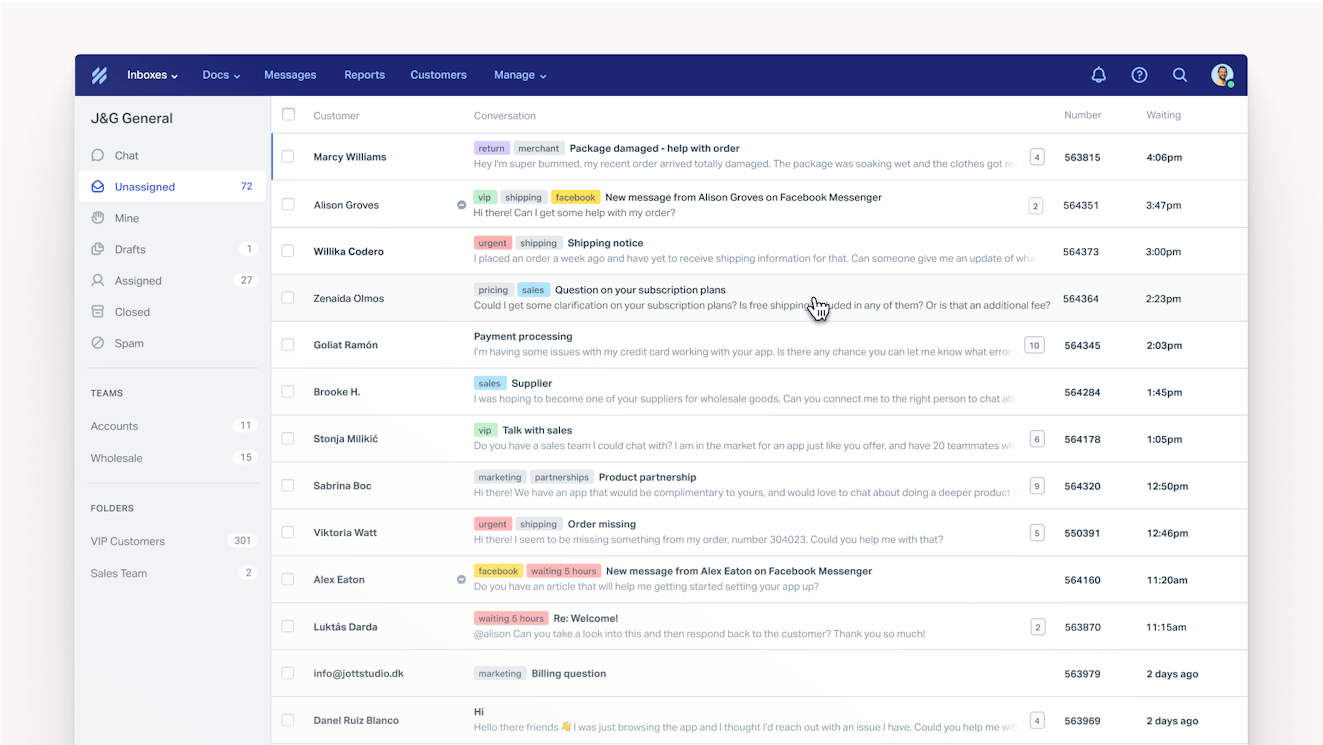
Help Scout is designed for companies where support is a revenue driver, not a cost center. It's perfect for growing SaaS and ecommerce companies that need to deliver great support to retain existing customers, property management and professional services companies where personalization is key, and healthcare and financial services companies where incorrect or inadequate responses can have serious outcomes.
Unlike other tools that are designed to "deflect" requests away from human support professionals, Help Scout gives your team the tools you need to manage requests more efficiently, respond more quickly, and build new ways for customers to find what they're looking for on their own.
All of the email requests you receive land in a shared inbox where your whole team can collaborate. You can assign conversations to specific individuals or teams both manually and automatically, create custom inbox views to see the conversations you care about the most, and add tags to requests to label them in ways that make it easy to search for and report on specific types of inquiries.
Build a library of saved replies to answer FAQs in just two clicks, or respond using AI Drafts, which writes a first draft for you based on past conversations. You can also use Help Scout to create a knowledge base so customers can find answers on their own. Then browse the articles directly in the email editor and easily insert links to them into your replies to provide additional context.
Collision detection alerts you when someone else is already replying to a customer so you can avoid duplicate work, and @mentions and internal notes let you have private discussions with teammates within a conversation. You'll also see a customer profile in a sidebar alongside all requests that helps you personalize replies and get the information you need to respond without changing tabs.
If you ever want to expand your support beyond email, Help Scout can help with that too. Add a live chat widget to your website and manage chat requests in your shared inbox, pull in requests from social media or messaging apps like Facebook and Slack, launch an AI agent that uses your knowledge base and website as sources, or add phone or SMS support by integrating with platforms like Aircall, Twilio, and more.
Pricing
Free plan and trial available. View Help Scout's current pricing.
Learn more about Help Scout:
2. Gmelius – Best for managing support requests in Gmail

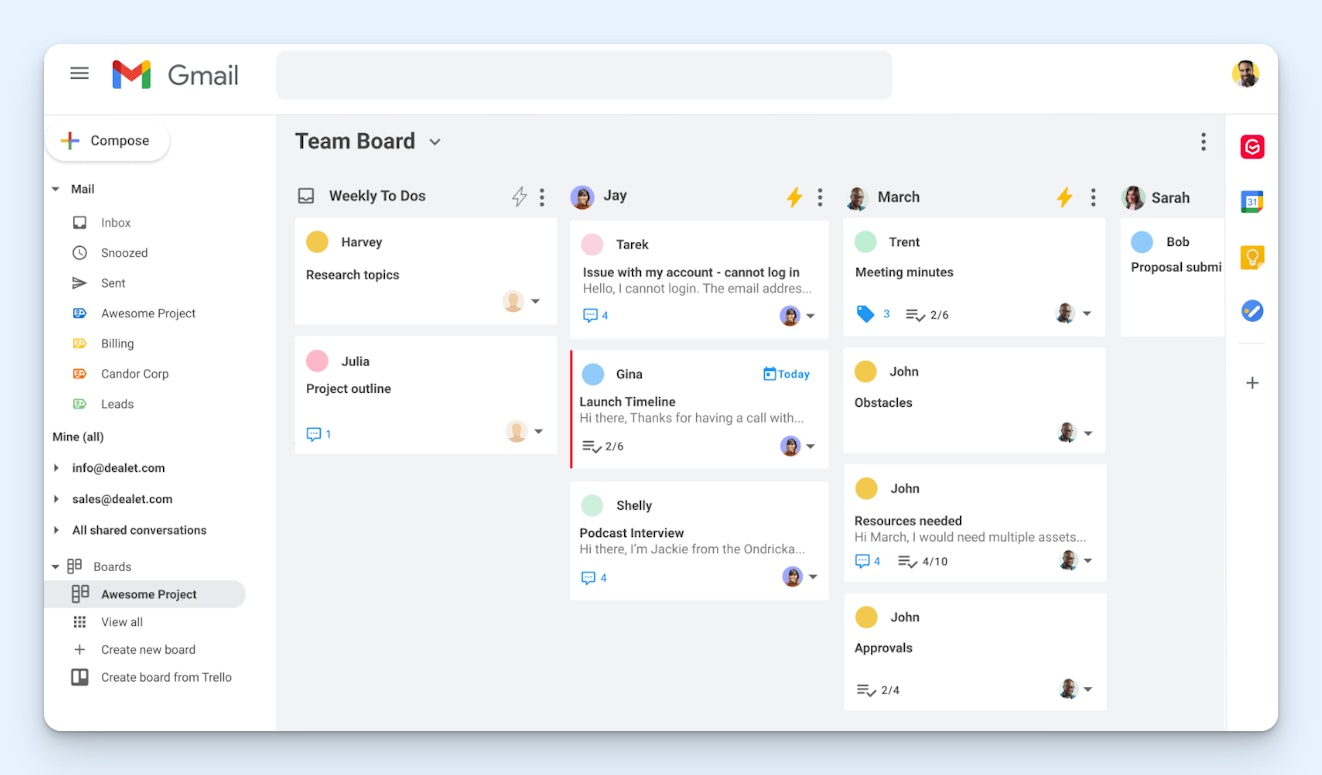
If you're currently managing support requests by sharing a login to an individual email account in Gmail or using Google Collaborative Inbox, Gmelius lets you upgrade your inbox without having to switch to a new platform. You can think of it as an extension that works on top of Gmail to add more collaboration and productivity features, activity and performance reports, and AI assistants.
Gmelius lets you create shared inboxes in Gmail that you can toggle into from the sidebar of your personal Gmail account. You add team members to the shared inbox to give everyone who needs it access, then you can assign emails to specific individuals, create shared email templates, leave internal notes, tag conversations, and create simple automations based on rules and criteria you set.
One of Gmelius' most unique features is its ability to display your inbox as a Kanban board. You can create labels for things like open, pending, and closed requests, then drag and drop them into the right lane as your team works through the queue. This can be more helpful than viewing them in a traditional list where it's more difficult to determine the current status of all of the emails.
For more complex workflows, Gmelius offers advanced features like round-robin and load-balanced routing and SLA rules. When it comes to reporting, you'll get pre-built reports showing things like trends in conversation volumes, team productivity, and performance toward your SLAs. On the Enterprise plan, you can also build custom reports, and you can export your reports as CSVs on the Pro and Enterprise plans.
Gmelius also has an AI assistant that you can purchase separately or as an add-on to the platform's shared inbox tools. The AI assistant works in both your personal and shared inboxes. It will sort and categorize your emails for you, draft replies to emails you receive that you can review before sending, help you schedule meetings, and summarize what's on your schedule for the day each morning.
Pricing
Free trial available. View Gmelius' current pricing.
Recommended Reading

3. Emailgistics – Best for managing support requests in Outlook

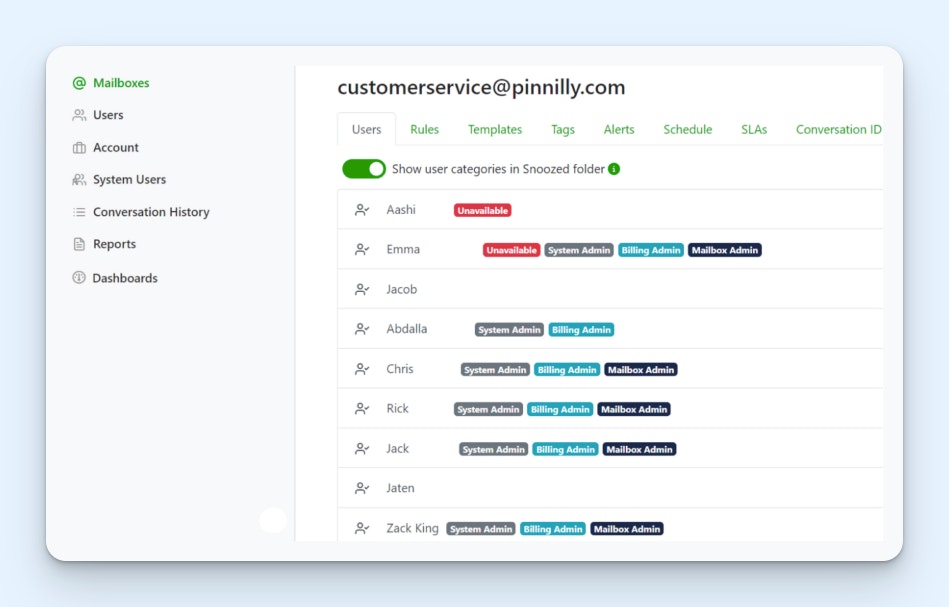
Emailgistics is similar to Gmelius, but where Gmelius lives in Gmail, Emailgistics lives in Outlook. It's an Outlook extension that adds support-focused features like assignments, reporting, conversation histories, internal notes, response templates, and AI summaries and replies to your Outlook mailbox.
You can create as many shared inboxes as you need using Emailgistics. When emails hit your inbox, you can assign them to specific individuals manually or automatically. For automated assignments, you can set specific hours for both your inboxes and employees so no one's assigned an email when they're not working. And users can toggle their availability off quickly to pause assignments temporarily.
Automated assignments can be made using round-robin or load-balanced routing. If an email comes in related to a request that someone on your team worked on previously, you can set the system up to automatically assign that request to the original owner. And you can also set up a backup assignee if the original owner isn't available.
Emailgistics lets you set and track SLAs, and once you've defined your SLA rules, the system will send a real-time notification when a reply has not been sent on time. You can also monitor SLAs in Emailgistics' reports that show response times, breach rates, and team performance toward targets.
Speaking of Emailgistics' reporting features, they're powerful. Monitor KPIs on your dashboard that updates in real time, view metrics for specific inboxes, or track performance by individual team members. You can also customize your dashboard with widgets and create custom dashboard views for different users.
Finally, Emailgistics has a couple of AI features that can help your team move more quickly. You can use AI to generate a summary of a long back-and-forth email conversation — or to automatically create a draft reply for you using information from your knowledge bases, FAQs, and other documentation.
Pricing
Free trial available. View Emailgistics' current pricing.
Recommended Reading

4. Hiver – Best free email ticketing system

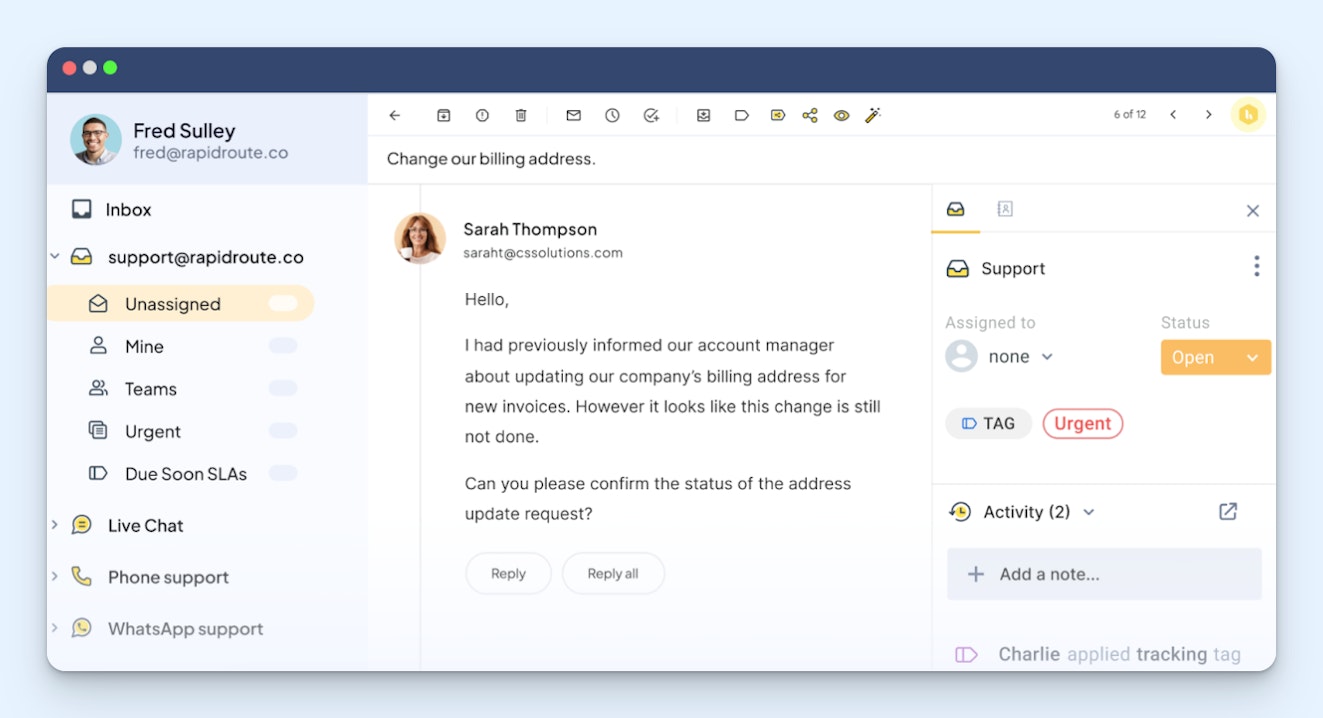
Hiver is unique because it can be used as a Gmail extension like Gmelius (Hiver for Gmail) or a standalone support platform like Help Scout (Hiver Omni). It also has one of the most generous free plans available in the support software market because it includes unlimited users. The free plans of the other (non-self-hosted) tools on this list all have limits on the number of users you can add.
Hiver's free plan lets you deliver both email and live chat support. You can create a single shared inbox, assign emails to individuals, have private discussions with teammates in notes, and build an external knowledge base. Some features in the free plan do have strict limits, however. For example, you can only create one tag and one saved reply, and the free plan does not include access to any reporting.
If you want to upgrade to a paid plan, one highlight of Hiver is that its AI features are included in paid plans with no additional costs. You can use AI to summarize back-and-forth email chains; clean up the spelling, grammar, and tone of replies you've written; and draft replies to emails. You can also launch an AI chatbot that answers customers' questions for you automatically via live chat.
Where most other tools charge usage-based fees for AI chatbots and agents that resolve customer requests for you, Hiver doesn't. That could make it appealing if you want to offer additional self-service resources to your customers but don't want to deal with unpredictable reply- or resolution-based costs.
Other more advanced team email management features you'll find in Hiver's paid plans include SLAs, CSAT ratings, collision detection, and round-robin, load-balanced, and skill-based routing. You can also use AI to build an internal help center from the replies your team has sent to customers to help with training new team members and providing information that your AI chatbot can use to write replies.
Pricing
Free plan and trial available. View Hiver's current pricing.
Recommended Reading

5. HubSpot Service Hub – Best for early-stage startups

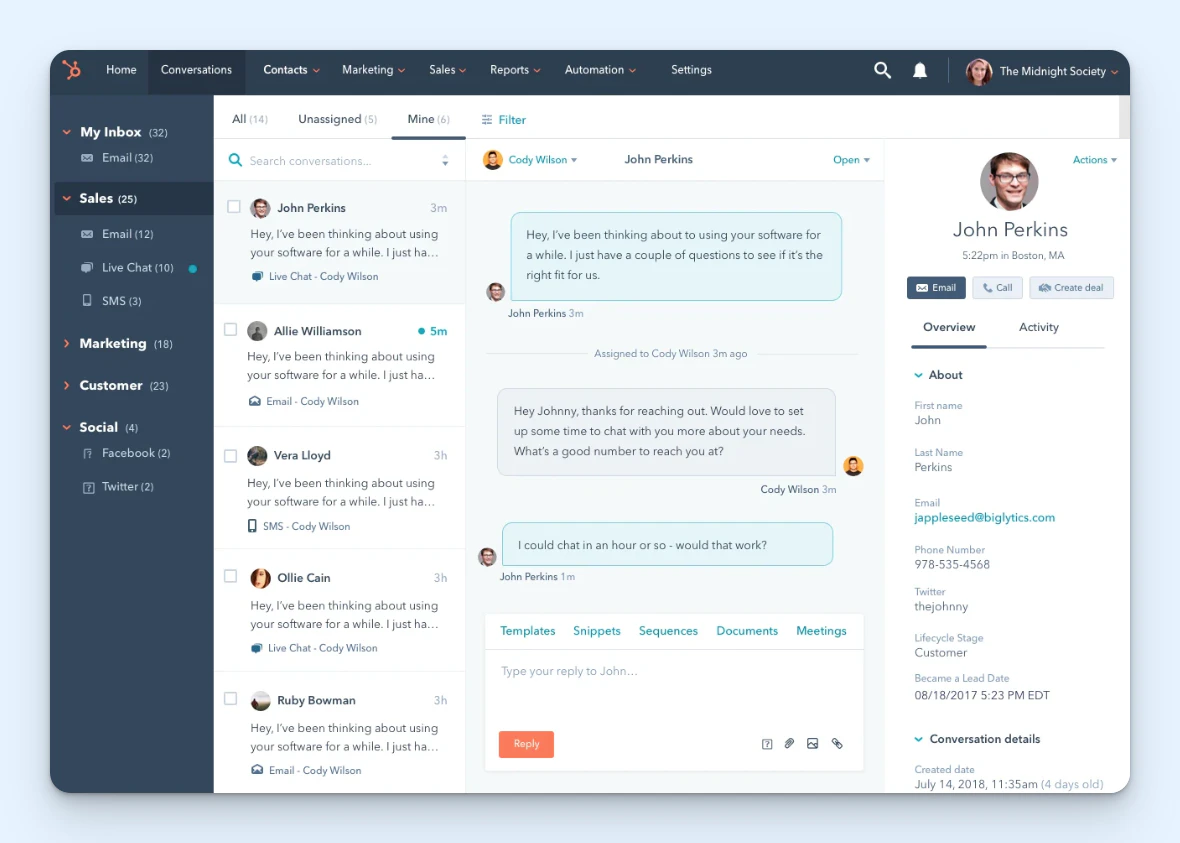
HubSpot's startup plan is a good deal for startups at the pre-seed, seed, or Series A stages of funding. It gives you a discount of as much as 90% off your first year (then 50% off the second year and 25% off the third) on HubSpot's CRM, marketing, and customer support tools. This lets you consolidate multiple teams' systems into one platform and enjoy a generous discount while you're still strapped for budget.
If you don't qualify for the startup discount, however, HubSpot Service Hub tends to be significantly more expensive than other options. While it has a free plan for two users and a low-cost Starter plan for email ticketing, many must-have features (like assignments, routing, collision detection, custom views, and workflows) are only included in its Professional ($90/seat) and Enterprise ($150/seat) plans.
Service Hub is especially useful for sales-led teams that have customer success or account managers supporting customers. You can quickly access all CRM data inside of the same tool you use for customer support, so it's easy to access email conversations between sales and new customers, watch meeting recordings that happened before the deal was closed, and view uploaded contracts.
HubSpot also has a customer success workspace that's unique among support tools. Customer success and account managers can add customers to their book of business and build auto-calculating health scores that display alongside each customer. Health scores can factor in things like support requests and customer feedback to give you a sense of how happy a customer is with your product.
Another highlight of Service Hub is its reporting capabilities. While all email ticketing systems come with default reports that let you dig into common support KPIs, HubSpot's reporting is completely customizable. You can build reports and add them to dashboards showing any specific pieces of data you need, filtered down by any conditions you want, and using data from all of your HubSpot systems.
Pricing
Free plan and trial available. View HubSpot Service Hub's current pricing or get details on its startup plan.
Recommended Reading

6. Dixa – Best for large ecommerce companies


Dixa is designed specifically for ecommerce companies. It takes a unique approach to email management: Instead of having all of your team’s emails moved into a shared inbox, Dixa automatically assigns each conversation to the team or employee who is best equipped to respond to the request.
To make this work, you set up detailed routing workflows in Dixa's no-code builder. You can route requests based on the skills your support professionals have, the languages they speak, and who's currently available, as well as customer attributes or request urgency. This ensures your team will spend more time focused on customer responses and less time managing the email queue.
Another benefit of Dixa for ecommerce companies specifically is that its private notes feature lets you have discussions with more than just your coworkers. You can also use notes to send an email to the manufacturers and logistics/fulfillment providers you work with to get products in stock and out to customers. This saves you from having to toggle between systems to get updates from third parties.
Dixa's AI agent can be used to not only answer FAQs automatically but also take specific actions based on customers' requests. It can process refunds, cancel orders, and update shipping information without a human having to get involved at all. It uses information from your knowledge base, website, any docs you upload, and the procedures you set for it to answer customers' questions and perform tasks.
If you want to offer more than just email support, Dixa is a complete omnichannel platform that lets you deliver email, chat, phone, social, SMS, and self-service support. It automatically recognizes customers regardless of which channel they use to contact you and lists all interactions (e.g., support conversations and orders) in a customer timeline alongside details like loyalty status and lifetime value.
Pricing
No free trial offered. View Dixa's current pricing.
Recommended Reading

7. Missive – Best for email requests that require more than just a reply


For many teams, delivering support is a matter of writing a reply. A customer has a question about how to do something in your software, needs clarification about an invoice, or is curious when a product will be back in stock: you may need to look up some information or ask a teammate a question, but resolving the request is a simple matter of writing a response and clicking send.
Missive is designed for when managing requests is more complex than that. It lets you turn incoming emails into trackable tasks without switching to a separate project management tool. Turn emails into tasks, create subtasks, assign them to users, and set due dates. The tasks will appear alongside the email so you can track their progress and know when everything's done before sending a reply.
Missive also lets you collaborate closely on writing replies. It has a private notes feature that lets you chat with teammates and external parties (even if they're not users in your Missive account). You can also have multiple users working on replies together in real time. Users can view drafts as they're being written and edit responses simultaneously — similar to collaborating on a Google Doc.
Other email ticketing features you'll find in Missive include canned responses, labels, and the ability to snooze emails or send them later. Snooze is great for emails with multiple tasks that you know will take some time to complete. You can have the email disappear from the inbox temporarily and reappear later to remind you to check in on the progress of tasks and reply to the customer if they're complete.
Finally, Missive also offers a handful of AI features to help your team work faster. You can generate a summary of a long back-and-forth conversation to get up to speed quickly, ask questions about your data and get AI-provided answers, generate draft replies to emails, and use AI as an assistant to help you prioritize by surfacing the most urgent emails in your inbox.
Pricing
Free trial available. View Missive's current pricing.
How to choose the right email ticketing system for your team
Every team has different needs. Some need simple tools to manage a low volume of emails. Others need powerful features like automation, reporting, or multi-channel support. The best email ticketing system for your team is the one that fits your workflows, scales with your growth, and doesn’t add unnecessary complexity.
Start by identifying your top priorities — whether that’s faster response times, better collaboration, or more visibility into performance — then test a few systems that feel like good solutions. Most tools on this list offer free trials, so you can get hands-on with the products before making a commitment.
If you’re running a lean support operation and want something intuitive, tools like Gmelius or Emailgistics might check all the boxes. Larger organizations with complex workflows may lean toward more robust options like Help Scout, HubSpot Service Hub, Dixa, or Missive. And if you're looking for something you can use for free, Hiver, Help Scout, and HubSpot all have options to consider.
With the right system in place, you’ll spend less time firefighting inbox chaos and more time delivering quality support.
Like what you see? Share with a friend.
Jessica Greene
Jessica Greene is a Help Scout alum, where we make excellent customer service achievable for companies of all sizes. Connect with her on LinkedIn or through her website.
Alexa Ahrens
Alexa is a content strategist at Help Scout, where she writes and helps other authors tell stories about customer experience, technology, and company culture. Before working in support and content creation, she worked at a wax museum — an experience that prepared her surprisingly well for a life of storytelling. Connect with her on LinkedIn.


