The 7 Best SaaS Help Desks: Reviewed and Compared



SaaS customer support is a difficult job. You're helping customers with complex issues that directly impact their ability to do their work. You likely work with many different users on the same account. Each customer’s environment may be customized and built uniquely for their needs.
The challenges are real, and that means choosing the right help desk for your SaaS business is an especially important factor in your customer support strategy and your company’s future growth.
A small startup doing founder-led support may just need a simple shared inbox. A developer-heavy company may want APIs to customize everything. An enterprise organization might prioritize compliance, integrations, and advanced analytics.
To help you find the right option for your unique situation, we've compiled this list of the seven best SaaS help desk software. Below, you'll find our detailed reviews that cover which types of teams each option is best for, what unique features they offer, and how they compare on price.
At Help Scout, we only publish deeply researched, human-written content. If you find our content to be as helpful as we strive to make it be, you can set us as a preferred source in Google so you'll see our content surfaced more often when you're searching.
| Platform | Summary | G2 Rating | Free Trial | Starting Price |
|---|---|---|---|---|
Help Scout | Best for SaaS companies that are setting up their first support department, Help Scout is an affordable and intuitive platform that works while you're small and scales as you grow. | 15 days | Free plan available; paid plans start at $25/user per month | |
Pylon | Best for early-stage startups delivering support via messaging apps, Pylon brings requests from Slack, Microsoft Teams, Discord, WhatsApp, and Telegram into a shared inbox. | Not available | $59/seat per month (three seat minimum) | |
HubSpot Service Hub | Best for sales-led startups, HubSpot syncs data between your help desk and CRM and has a customer success workspace with books of business and health scores. | 14 days | Free plan available; paid plans start at $7/seat per month | |
Plain | Best for engineering-led support, Plain can be fully customized using its GraphQL API, lets you build a headless portal that can be embedded in your app, and supports custom-built agents. | 7 days | $35/seat per month | |
Gmelius | Best for bootstrapped startups, Gmelius turns your Gmail inbox into a help desk, letting you collaborate on email requests as a team, assign inquiries to team members, and access reports. | 7 days | $25/user per month | |
Intercom | Best for rapidly growing SaaS companies, Intercom has AI built into every aspect of its platform, and its AI agents can answer customer questions and perform actions across all channels. | 14 days | $29/seat per month | |
Zendesk | Best for public SaaS companies, Zendesk lets you deliver support across all channels, has several AI features available, and is highly customizable by both support admins and developers. | 14 days | $19/agent per month |
1. Help Scout – Best for SaaS companies that are setting up their first support department


Help Scout is built for SaaS companies that are standing up their first support department. It won't strain your budget. It's intuitive enough that new hires can start helping customers on day one instead of spending weeks in training. As your team and customer base grow, it scales alongside you. And most importantly, it helps your team reply to customers quickly without cutting corners on quality.
Help Scout has you covered no matter which channels you want to use for customer support. You can manage requests from email, live chat, Slack, and social (Facebook Messenger, Instagram, and WhatsApp) from a single shared inbox. Enable a single channel while your team is small, then add others later as customers request them and your team grows large enough to support multiple channels.
When it comes to customer self-service, Help Scout has you covered. Build a knowledge base, host it on your own domain, and customize it to match your branding. Once it's live, you can turn on AI Answers. AI Answers use generative AI and the content of your knowledge base and website to answer customers' questions 24/7. It lives in Beacon, a web widget that can be embedded on your website or in your app.
For questions that AI can't answer, there are lots of features to help your team collaborate, stay organized, and send quality responses faster. Create teams for different departments (support, engineering, finance, HR, etc.), then set up workflows to automatically assign incoming requests to the right team. Or @mention a teammate in an internal note to get the information you need to reply to a customer.
Round-robin and load-based routing can assign incoming requests to your support team members evenly. Create a library of saved replies to answer FAQs in a couple of clicks. Or get a first draft of responses with AI Drafts. AI Drafts will compose a reply to a request for you using information from previous replies your team has sent. Simply generate a draft, edit it if needed, and hit send to reply to the customer quickly.
Finally, Help Scout's integrations make it easy to get the context you need directly in your help desk without switching tabs. You can integrate with CRMs like HubSpot and Salesforce, issue tracking tools like Jira and Linear, business intelligence tools like Census, and CMSs like WordPress. There's also a robust API and webhooks you can use to connect Help Scout to any app you need, including proprietary tools.
Pricing
Free plan and trial available. View Help Scout's current pricing.
Learn more about Help Scout:
2. Pylon – Best for startups supporting customers via Slack or Teams

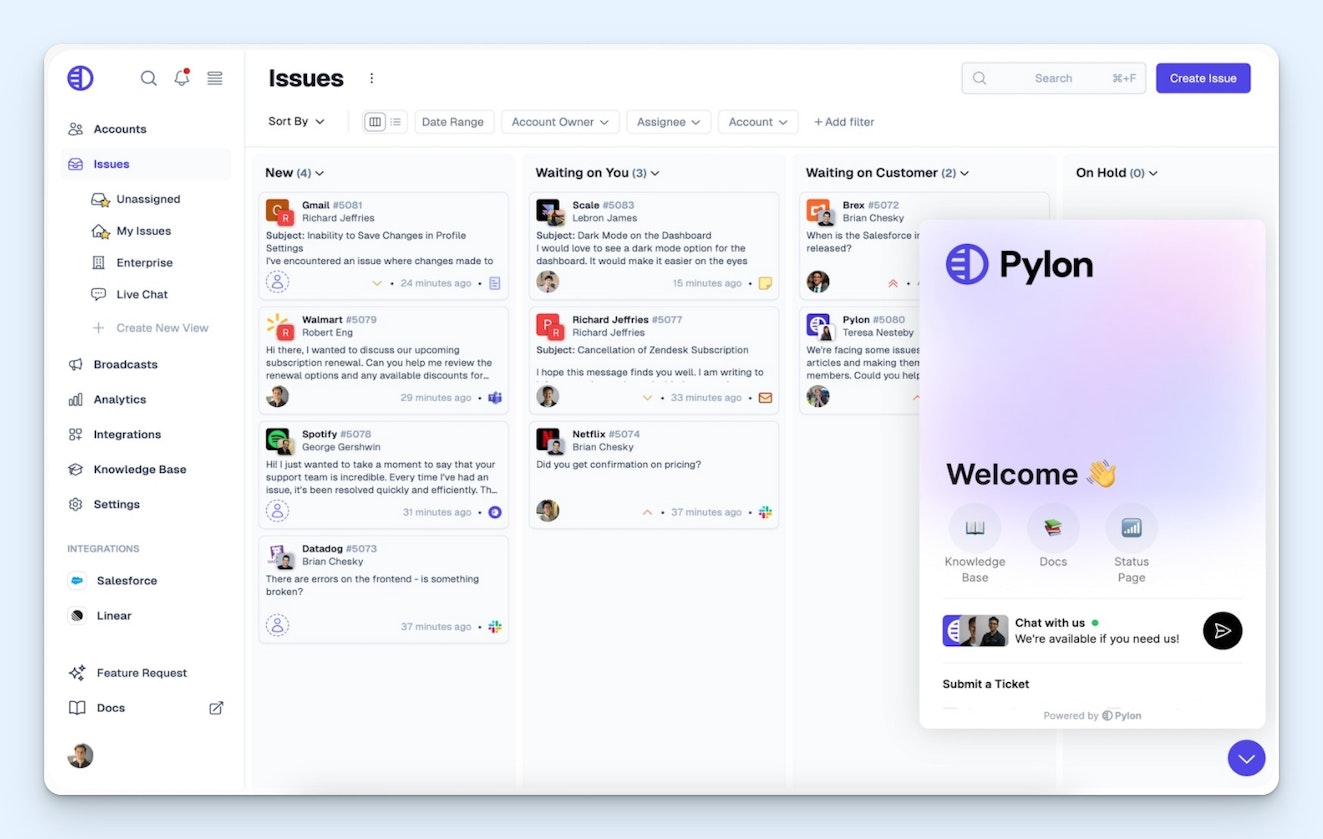
It's common for early-stage startups to create support channels for their first handful of customers in messaging apps like Slack and Microsoft Teams. This makes sense because your founders, engineers, and sales team already spend all day with the messaging app open, so it makes it easy to deliver all-hands support. Plus, the real-time support makes your customers feel like they're a priority.
While lots of help desks offer a Slack integration, Pylon is one of the few that also integrates with Microsoft Teams. This may not be necessary if your customers are primarily other startups, but if you're targeting enterprise deals, it's a must-have. Both the Slack and Teams integrations pull customer requests from those platforms into Pylon so you can view and reply to them without leaving your help desk.
When you've inevitably grown out of the stage where you can manage support in messaging channels, Pylon can grow alongside you. You can add channels for email and live chat support, build a knowledge base and intake forms, and connect with other messaging channels like Discord and Telegram. You can also build personalized, gated portals that are customized to accommodate your largest customers.
As far as AI features go, Pylon offers AI Agents and AI Assistants. AI Agents can answer customers' questions automatically and run specific workflows that you build. AI Assistants can route requests, help you write knowledge base articles, identify similar articles in your knowledge base, summarize long back-and-forth conversations, and translate incoming and outgoing messages into other languages.
The one big downside of Pylon is that it's pricey for early-stage SaaS companies. The Teams integration is only available on the Enterprise plan, which costs $139/seat per month and has a seven-user minimum. AI Assistants and AI Agents are only available via add-ons, which are an additional $50-$100/seat per month. Even its base plan is more than twice the cost of some of the other options on this list.
Pricing
No free trial available. View Pylon’s current pricing.
3. HubSpot Service Hub – Best for sales-led startups


HubSpot Service Hub is the support-focused portion of HubSpot's ecosystem, which also includes a CRM, marketing automation platform, and data and revenue hubs. Pre-seed, seed, and Series A startups can get access to all of HubSpot's hubs at a discount of up to 90% in the first year. This makes it a good fit for sales-led teams where sales and customer success need to collaborate closely on supporting customers.
First, the connection between HubSpot Service Hub and CRM makes it easy to share data across teams. You can upload contracts for new or renewal deals into the CRM, and your customer success and account management teams can build links to those contracts in the company profiles they use. Support team members can also access all conversations sales had with new customers to get up to speed quickly.
HubSpot also has a customer success workspace that shows you your entire book of business in a single view. You can set up customer health scores that factor in specific interactions you specify. For example, positive customer feedback might add points while requesting customer support might deduct points. The health scores are color-coded and provide you with an easy way to identify churn risks.
HubSpot also lets you create individual portals for specific customers, set SLAs for response times, and send pre-built Net Promoter Score, customer effort score, and CSAT surveys. As far as typical help desk features, you can deliver email, live chat, social, phone, and SMS support, and you can create a knowledge base and launch an AI Agent to answer prospect and customer questions instantly.
HubSpot's tools are a good choice if you think your company will grow rapidly. The startup plan gives you a discount of up to 90% in the first year, 50% in the second year, and 25% in the third year, but the cost increases dramatically when your discount expires. It's a factor that's worth considering early on because moving multiple teams to a different system if you can no longer afford HubSpot is a major effort.
Pricing
Free plan and trial available. View HubSpot Service Hub's current pricing or get details on its startup plan.
Recommended Reading

4. Plain – Best for engineering-led customer support

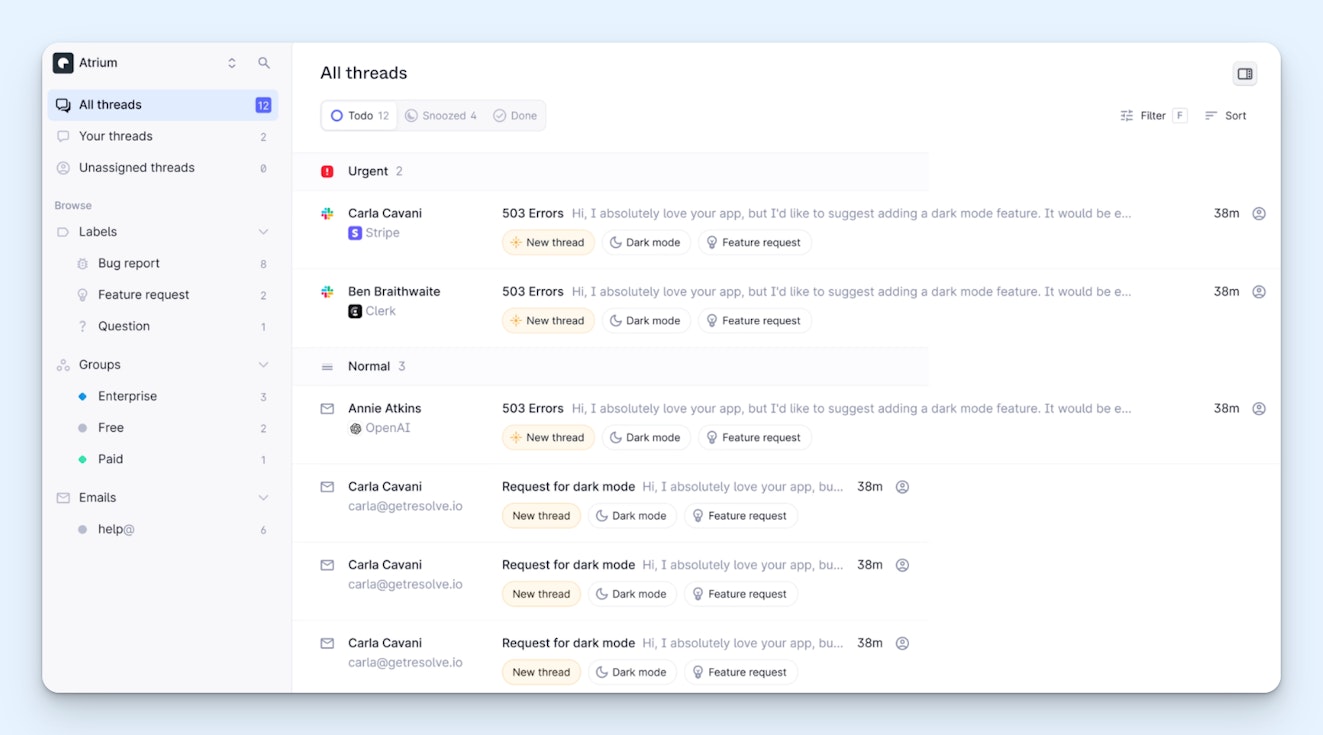
If you're selling a product that's designed for developers, engineers, and other highly technical teams, your support team likely needs to be very technical too. In fact, you may have engineers supporting your customers. If that's the case for your team, a standard help desk may not be what you're looking for. You may want something that's much more customizable, and Plain may be the perfect solution.
When you first launch Plain, you'll get access to the default setup, but if there's anything you don't like about it or want to change, you can customize it using its GraphQL API. There's a fully typed SDK you can install from npm, you can set up machine users to take actions like escalating requests or replying to customers, and you can plug in your own AI agents to handle and respond to customer inquiries.
If you don't want to build your AI agents from scratch, Plain has a number of pre-built AI features you can use out of the box. There's an AI agent that answers customers' questions automatically across all channels, an AI Assistant that answers questions for your team and references its sources, and an AI reporting tool that tracks your performance, groups issues, and surfaces insights to help you improve.
Because it's built for technical teams, Plain offers pre-built integrations with the other tools those teams use. You can link a support thread to an issue in Linear, Jira, Shortcut, or GitHub. Plain also integrates with incident management tools like incident.io and Rootly so you can create or link an incident from a conversation and keep affected customers in the loop.
Plain lets you support customers via email, live chat, Slack, Discord, and Microsoft Teams. You can build a help center and create a headless portal that can be embedded directly into your product's UI. Additional customizations include the ability to define custom fields to extend Plain's data model to match your own and build customer cards that pull real-time data from your internal systems into the conversation.
Pricing
Free trial available. View Plain's current pricing.
5. Gmelius – Best for bootstrapped startups

If you're a bootstrapped startup juggling building your platform, acquiring customers, and handling support with a small team of founders, sales reps, and engineers, you're likely managing support in your personal email inboxes. The problem with supporting customers out of personal inboxes is that it's easy for requests to slip through the cracks and go unanswered because someone was busy or on vacation.
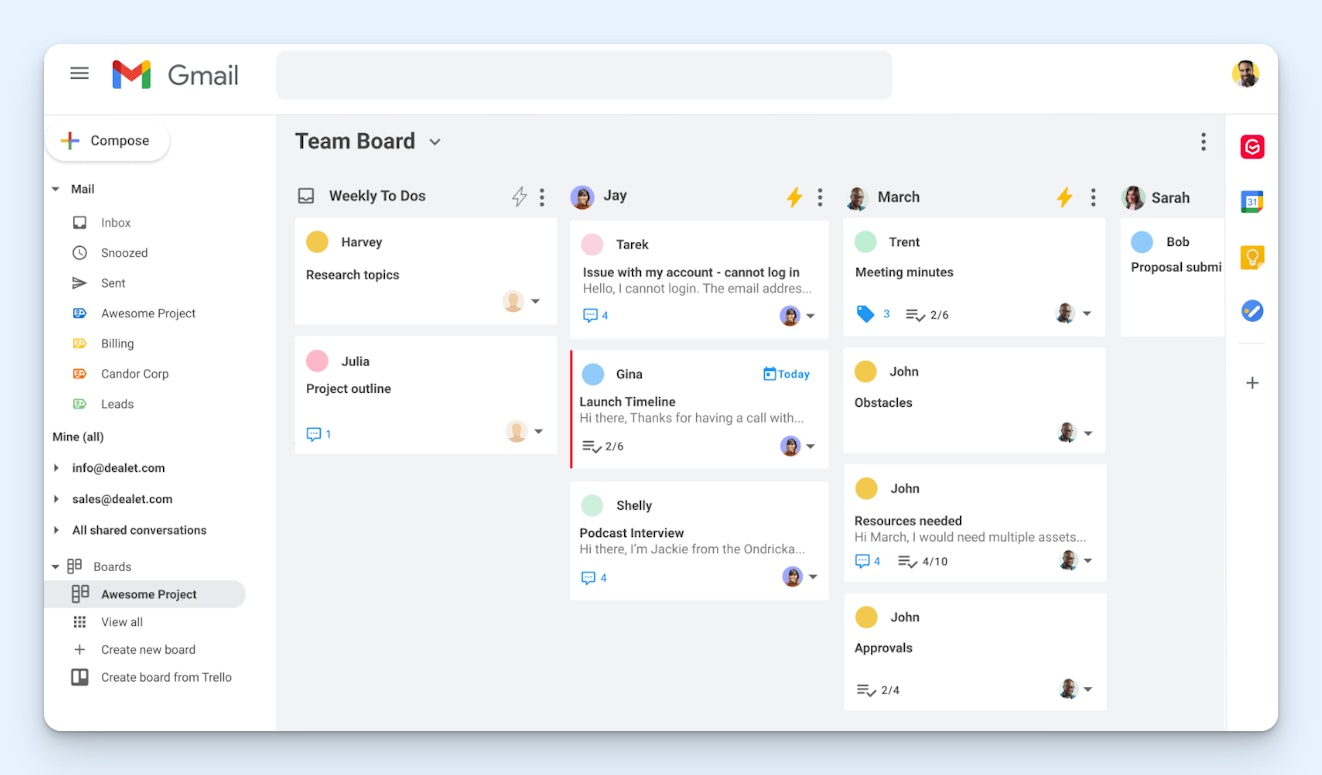
Gmelius transforms Gmail into a more robust help desk. You can create a support email address (e.g., support@ or help@), add your coworkers to it, and give everyone access to it alongside your personal email in a separate folder. Simply click on the name of the shared inbox to see all requests sent to your shared support email account, then you can reply to all requests from within Gmail's interface.
The advantage of using Gmelius over a free tool like Google Collaborative Inbox is that Gmelius adds a lot of features that will help you stay organized and collaborate more efficiently. There's a collision detection feature that lets you know if someone else is already replying to a request, and manual and automated assignments let you create accountability by specifying who needs to reply to an email.
There's also an AI assistant that can help you manage your email more efficiently. At the start of each day, the AI assistant will sort your inbox, write draft replies to emails you've received, and give you an overview of your day. It can also help you schedule meetings so you can ditch your meeting scheduling tool.
It's worth noting that Gmelius only lets you deliver email support, so if you want to expand into other channels as you grow, you'll have to switch to a different help desk. However, it's an affordable and lightweight option that will help you stay on top of requests while your company is small and has a limited budget, and you can always switch to a new tool when it's time to build your first support team.
Pricing
Free trial available. View Gmelius' current pricing.
Recommended Reading

6. Intercom – Best for rapidly growing SaaS companies

If your company is growing faster than you can hire new team members to manage all of the support requests you're getting, Intercom is a good option to consider. It's built AI into nearly every aspect of its platform, so it can help you scale support without having to dramatically increase your headcount.
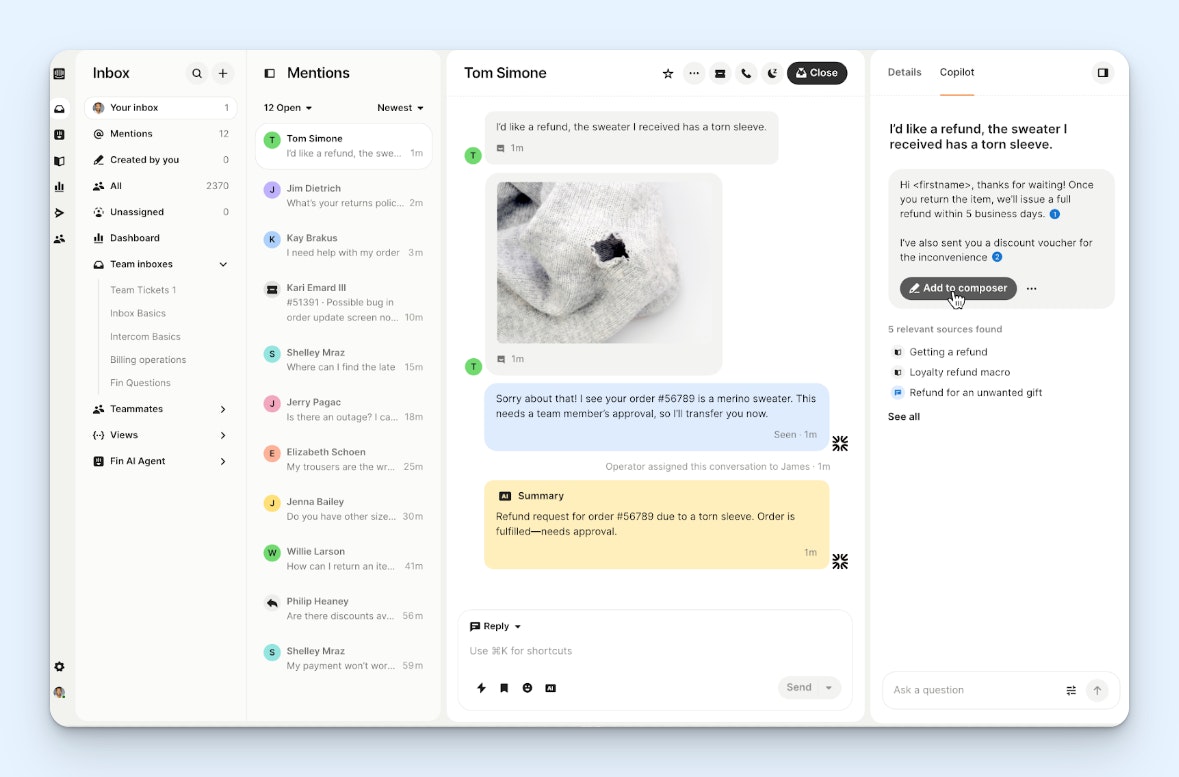
Intercom's AI agent, Fin, answers customer requests automatically across all channels. It's built on Intercom's proprietary model that's been trained on billions of customer support interactions; answers questions using information from your knowledge base, website, and any documents you upload; and can even make changes in other systems for you, like updating account information or processing refunds.
Fin is highly customizable, so it can handle complex queries rather than just answering FAQs. You can build procedures into it so it can handle multi-step processes — even those that require pulling data from and pushing data to third-party systems. You can also set up guidelines for how Fin responds, adjusting things like its tone of voice, level of professionalism, and complexity of vocabulary.
Finally, you can test Fin in detail before you launch it for your customers. Before launching, you can run as many simulations of real customer conversations as you'd like, and any simulations you run are kept in a simulation library so you can run them again after making changes to procedures. After launch, Intercom provides you with AI-generated improvement opportunities so you can further optimize its performance.
If you like Fin but want to use another help desk, it can also integrate with your existing help desk to be used as a standalone AI agent. There are pre-built integrations available for Salesforce, Freshdesk, and HubSpot, and you can integrate it with other help desks using Intercom's API.
Beyond Fin, Intercom has several other AI features. Topics automatically categorize incoming requests and show you support volume metrics by topic, CX Score automatically adds CSAT ratings to all support conversations, Copilot acts as an assistant to your agents by answering their questions and suggesting responses and next steps, and Monitors alerts you to quality issues in your responses.
Pricing
Free trial available. View Intercom's current pricing.
Recommended Reading
7. Zendesk – Best for public SaaS companies

Zendesk is an enterprise-focused help desk that lets you manage really anything you need to manage when it comes to customer support. You can use it to deliver support across all channels — email, live chat, social, SMS, and phone — and launch self-service resources like help centers, community forums, customer portals, and AI agents. It's also highly customizable, so it adapts to complex workflows.
That customizability is one of Zendesk's biggest strengths, and you can approach it from either end of your team. Non-technical admins can shape the platform using no-code tools: business rules and triggers automate routine actions, and a no-code flow builder lets you create workflows that span multiple systems. Plus, there are nearly 2,000 pre-built integrations with other third-party systems.
When you need to go further, your development team can build custom apps with Zendesk's app framework and SDKs, model your own data with custom objects, and connect anything else through Zendesk's APIs and webhooks.
Like the other tools on this list, Zendesk has invested heavily in AI. Its AI agents can resolve customer requests automatically across any channel. For the requests that do reach your team, Copilot works alongside your agents, drafting replies or suggesting the next best step. Zendesk QA uses AI to score both human and AI interactions so you can catch issues before they become major problems.
When it comes to reporting, you get a unified reporting hub with prebuilt dashboards, the ability to build custom reports on the metrics that matter to your business, and AI-powered recommendations that surface trends across channels. You can schedule reports, share them with stakeholders, and drill into nearly any dimension of your support data without having to download a single CSV.
The tradeoff for all of that power is cost and complexity. Zendesk is one of the pricier options on this list, and its pricing has a lot of moving parts: seats are billed per agent, AI agent resolutions are billed based on usage, and many features are sold as add-ons. It's a lot to take on for a small team, but for a large, established SaaS company that needs to support customers at scale, it's hard to beat.
Pricing
Free trial available. View Zendesk's current pricing.
Recommended Reading
How to choose the best SaaS help desk for your company
The challenges of SaaS support are unique. The good news is that there’s a help desk out there for everyone; the bad news is that finding the right solution for your support team can be tough.
When evaluating SaaS help desk platforms, here are some key factors to keep in mind:
Channels: Do your customers live in Slack, in Teams, in your app, on social, or in email? The channels you need to support should have a major influence on the help desk software you consider.
Team and company maturity: Startups usually need simplicity; larger teams often require more compliance and customization. Your company stage will affect the tools that make sense for you.
Integrations: Take a look at the rest of your tech stack. The right SaaS help desk for you is the one that works well with your CRM, analytics platform, and other tools.
Compliance: If you’re in a regulated industry or serving enterprise B2B customers, things like SOC 2 Type II, HIPAA, and GDPR are often essential.
Pricing model: Costs impact scalability in different ways. Consider which option makes the most sense based on your support model, customer types, current stage, and available budget.
Ultimately, there's no single best SaaS help desk — only the one that best fits where your team is right now. Start with the channels your customers actually use, be honest about your stage and your budget, and try to choose an option that will work for you not only today but also a year or two from now.
Like what you see? Share with a friend.
Jessica Greene
Jessica Greene is a Help Scout alum, where we make excellent customer service achievable for companies of all sizes. Connect with her on LinkedIn or through her website.
Neal Travis
Neal is a curious learner and builder of customer experiences in scale-ups. He is the Head of Customer Experience at the Academy to Innovate HR (AIHR) and Host of Growth Support.


