The 7 Best Healthcare Customer Service Software & CRMs


Healthcare is a broad industry that covers everything from solo doctors offices to global pharmaceutical companies. The right customer service software or CRM for your healthcare company will depend heavily on what types of services you provide, who your customers are, which laws you need to stay compliant with (and which don't apply to your organization), and how much you can afford to spend on software.
To help you find the right option quickly, we've rounded up seven of the best healthcare customer service and CRM platforms, each built for a specific kind of healthcare business, with notes on features, pricing, and who each one is best for.
At Help Scout, we only publish deeply researched, human-written content. If you find our content to be as helpful as we strive to make it be, you can set us as a preferred source in Google so you'll see our content surfaced more often when you're searching.
| Platform | Summary | G2 Rating | Free Trial | Starting Price |
|---|---|---|---|---|
Help Scout | Best for growing HealthTech companies, Help Scout delivers all of the security, automation, and collaboration features you need at a fraction of the cost of other tools. | 15 days | Free for up to five users; paid plans start at $25/user per month | |
Agentforce Health | Best for hospitals and insurance companies, Agentforce Health is a robust platform that can be upgraded to add in Salesforce's customer support tools. | 30 days | $350/user per month for Agentforce Health only; $750/user per month for Agentforce Health and Service | |
Talkdesk | Best for busy healthcare call center teams, Talkdesk offers features like AI agents, AI copilots, and AI identity verification that reduce your team's workload. | Not available | $85/user per month | |
Tebra | Best for elective healthcare providers, Tebra is an EHR with practice marketing and patient messaging tools that make it easy to communicate with patients and get reviews. | Not available | Contact for pricing | |
SimplePractice | Best for independent providers, SimplePractice is an affordable EHR and patient communication platform with tools for messaging, scheduling, and billing. | 30 days | $49 per month | |
Gladly | Best for health and wellness retailers, Gladly's customer timeline feature makes it function like a CRM, and it integrates with the most popular ecommerce platforms. | Not available | Contact for pricing | |
Veeva Vault CRM | Best for life sciences companies, Veeva lets sales reps create detailed records of all of their meetings and includes multiple features to help you stay compliant. | Not rated | Not available | Contact for pricing |
1. Help Scout – Best for HealthTech companies


Help Scout is a great option for growing HealthTech companies. While it's just as powerful as enterprise-focused alternatives like Zendesk and Intercom, it's more affordable and more intuitive to use. It has all of the features your technical team needs to customize the platform to your specifications, as well as everything your support team needs to collaborate, keep requests organized, and respond quickly.
On the technical side of things, Help Scout can be configured to be HIPAA compliant, has pre-built integrations with the software SaaS companies commonly use — like Salesforce, HubSpot, and Jira — offers a well-documented API for connecting to systems without pre-built integrations, and offers security-focused features like advanced permissions and SSO/SAML. It's also SOC 2 Type 2 certified.
The platform can be customized in multiple ways. Create custom fields, then build automated workflows that trigger specific actions based on what was entered into a custom field. Set up SLAs to ensure requests are handled in a timely manner, and turn on round-robin or load-balanced routing to assign requests automatically. Create teams to filter requests by the responsible party, or create multiple inboxes for different teams to ensure people only see the requests they're responsible for (or allowed to view).
When it comes to supporting customers, Help Scout's Inbox consolidates all of the requests you receive across email, live chat, and social (Facebook Messenger, Instagram, and WhatsApp). You can reply to requests quickly using pre-written saved replies, use AI Drafts to automatically compose a custom reply (based on historical conversations) that you can review and edit before sending, or set up AI Answers to respond to customer requests instantly using knowledge from your help center.
You build your help center in Help Scout's Docs, which can be used to create both external and internal knowledge bases. Create articles, then sort them into categories and collections. Your Docs site can be customized to match your branding, and customers can easily find what they're looking for using on-site search, search engines, or a Beacon widget that can be embedded on any page of your website or app.
The Beacon widget can also be used to proactively message customers while they're viewing your website or working within your product. Pop up a message asking them to fill out a CSAT or NPS survey, suggest a knowledge base article that might help them complete a task they're struggling to perform, or alert them to issues like system outages, informing them when things will be back up.
Pricing
Free plan and trial available. View Help Scout's current pricing.
Learn more about Help Scout:
2. Agentforce Health – Best for hospitals and insurance companies

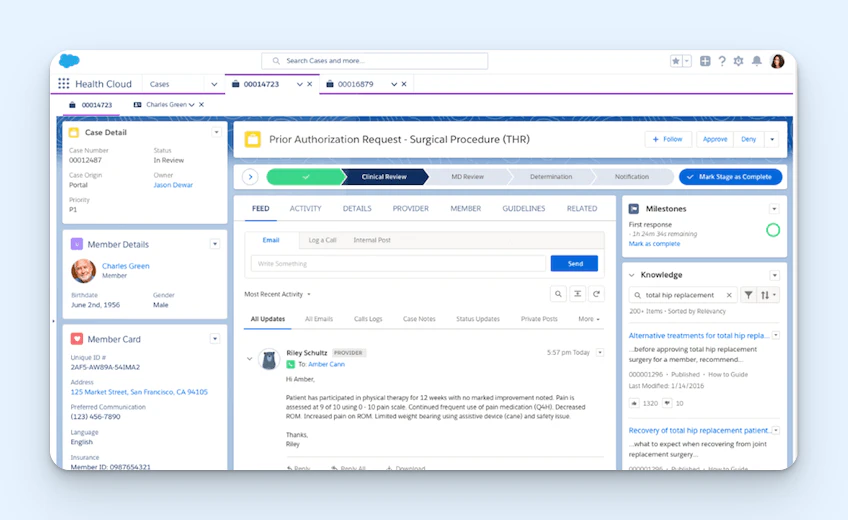
Agentforce Health (formerly Salesforce Health Cloud) is a healthcare-specific version of the company's CRM that can be combined with Salesforce's support software, Agentforce Service, to give you access to both relationship management and support tools in a single, consolidated platform.
Agentforce Health caters to healthcare companies by preconfiguring the tool to reflect how healthcare works. Instead of general CRM labels like accounts, leads, and opportunities, you can classify "customers" as patients, members, and/or providers; the labels are customized based on your business type (provider, insurance company, medical device company, etc.). There are also pre-built fields for collecting relevant information like medical conditions, current medications, and ongoing care plans.
On the Health Cloud Agentforce 1 for Service plan (or as an add-on to lower-cost plans), you get access to both the CRM and Salesforce's support software. With its support software, you can manage requests from patients or members across every channel — email, live chat, phone, SMS, and social. You can also build a knowledge base or create secure portals that require a login to access.
If you're interested in automation, AI agents can reply to incoming questions across all channels, understand uploaded images and videos, and route requests to the right person/team automatically. AI rep assistants are also available to help your team out by summarizing conversations, offering recommendations, and even turning support responses into knowledge base articles in your help center.
On the CRM side of things, AI agents can help patients get appointments scheduled and contact insurance companies for eligibility checks or to get an update status on claims. For home healthcare teams, agents can recommend services to offer to patients. And for providers, AI can view lists of symptoms and test results and make a determination on whether an issue is probable or confirmed.
Agents can be built using low-code tools and pre-built templates and tied to industry-specific data models. The platform has native support for HL7 and FHIR, and Agentforce Health is HIPAA compliant out of the box. Finally, you can also connect the platform with EHRs and payer networks using MuleSoft Direct, which allows you to pass data back and forth between systems using FHIR APIs.
Pricing
Free trial available. View Agentforce Health's current pricing.
Recommended Reading

3. Talkdesk – Best healthcare call center software


Large healthcare organizations and insurance providers that deliver phone support from a call center should check out Talkdesk. The platform can be used to deliver support over email, chat, social, and SMS, but phone support is where it really stands out. There's a visual builder you can use to create an IVR system, inbound and outbound calling functionality, and tons of ways to speed up operations using AI.
Talkdesk's AI agents can be deployed to answer patients' questions automatically over the phone, but in addition to answering questions, agents can also perform actions. They can reschedule appointments, manage prescription refills, and process payments — all in multiple languages without a human needing to get involved. When human help is needed, AI agents route the request to a live rep for assistance.
There are also AI copilots that listen to phone conversations, analyze sentiment and intent, and use that information to provide real-time recommendations to support team members, such as answers they can recite for specific questions, recommendations for next steps, or step-by-step guidance. When a call is completed, AI automatically generates a summary of the call for reference and saves it in Talkdesk.
Additionally, Talkdesk offers an AI identity validation system, Talkdesk Identity, that you can place before support rep or AI agent interactions to validate that patients are who they say they are before support is provided. It uses voice biometrics technology to validate identities by asking the caller to repeat a phrase. There's also a risk scoring system that highlights if a call is likely an attempt at fraud.
Talkdesk offers pre-built integrations with EHRs like Epic, Oracle, and Athenahealth. A Talkdesk widget can even be embedded directly into Epic Cheers so reps can handle calls without leaving Epic's interface, placing all of the information they need at hand. Talkdesk's AI copilots can also access Epic data to provide more personalized recommendations to reps.
Finally, if you're interested in Talkdesk's AI agents but already have a contact center platform your team uses and likes, you can purchase its AI features à la carte and use them on top of your existing system, whether it's hosted on-premises or in the cloud.
Pricing
No free trial offered. View Talkdesk's current pricing.
Recommended Reading

4. Tebra – Best for elective healthcare providers


Tebra is a robust platform that combines an EHR with tools for billing and payments, patient experience and messaging, and practice marketing. Its practice marketing tools make it ideal for the types of practices where patients find you through an online search rather than as a referral from a PCP or by searching their insurance network, such as therapists, plastic surgeons, chiropractors, and fertility clinics.
Inside of Tebra, you can optimize your Google Business profile for higher search rankings, use AI to quickly write responses to online reviews, and build public profiles for your practice where patients can get information and schedule appointments. You can also build workflows that automatically send review requests to patients after their appointments to encourage them to write a review about their experience.
When it comes to communicating with patients, you can set up automated appointment reminders that are sent via either email or text message, customizing when the messages are sent and what content they include. Patients can also contact you via email or text, and the messages show up in and can be responded to in your Tebra portal. Pre-written replies can also be created for templated responses.
If you want to engage with patients proactively, you can message patients individually using contact info from your EHR, or you can set up messages to be sent automatically for things like reminding them to schedule a follow-up appointment that's not on the books yet. There's also a broadcast messaging tool you can use to message multiple patients to let them know about office closures or new promotions.
Finally, Tebra's EHR makes it easy to document all patient details, take notes using SOAP templates, send prescriptions to pharmacies electronically, order lab tests and view results, and host telehealth appointments. Its billing system lets you create invoices for services automatically, and patients can log into a secure patient portal to pay their bills, review messages they've received, and complete paperwork.
Pricing
No free trial offered. Contact Tebra for pricing.
5. SimplePractice – Best for independent practices


For independent practices that don't need all of the bells and whistles of Tebra, SimplePractice is an affordable option that gives you lighter-weight practice management and customer communication features. It can be used for patient scheduling, collecting payments, documenting visit notes and treatment plans, managing insurance claims, and creating a client portal for communicating with patients.
You can create an office schedule in SimplePractice that your front office team manages manually, or you can open it up for patients to schedule (and reschedule or cancel) appointments themselves. You can set it up so that new appointments must be approved by someone in your office before they're added to your calendar, and the system automatically sends patients appointment reminders via email, phone, or text.
You can also use the system to collect patient information electronically. Have them enter basic details online when setting up their appointment, then follow up with a text or email asking them to fill out required forms before their visit. All of the information is stored electronically in SimplePractice alongside visit documentation, treatment plans, and other clinical notes.
As far as communicating directly with patients, you can manage all communications through SimplePractice's portal. You can message patients individually, send broadcast messages to a group of patients, and set up auto-replies to let patients know when you're out of the office. All messages you receive from patients show up in SimplePractice regardless of how they sent the message (via email, text message, or using the client portal itself).
Finally, you can also create bills automatically in SimplePractice, send them to patients, and collect payments through the portal. There's an AI-powered notetaker that can listen to your appointments and create notes that you can review and edit quickly when the appointment concludes. And the platform offers lots of templates for things like treatment plans and patient forms to help you get set up quickly.
Pricing
Free trial available. View SimplePractice's current pricing.
6. Gladly – Best for retail health and wellness brands

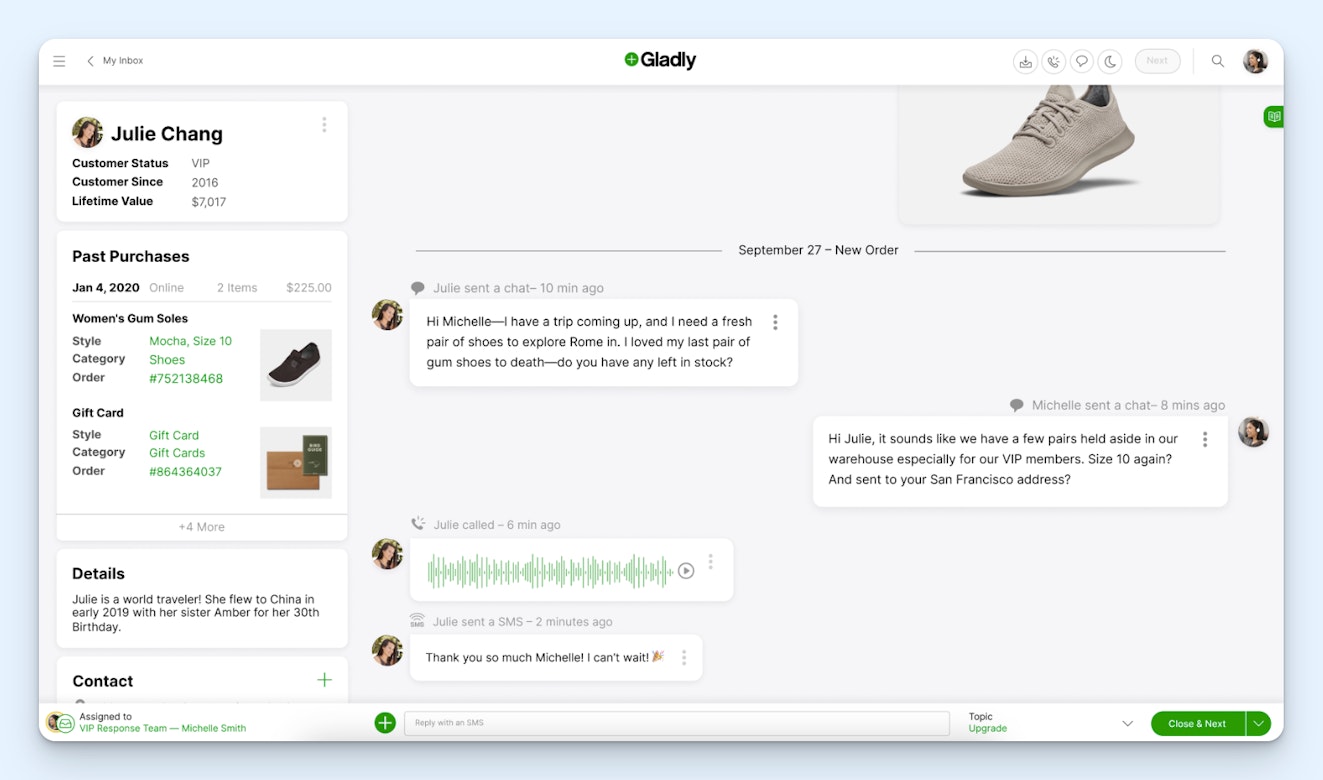
If you're running support for a health and wellness retailer — whether you have in-person shops, an online ecommerce store, or both — Gladly is a good option to consider. It brings all of the interactions you have with specific customers together into a single timeline. You get a complete history of customer transactions and conversations in one place, making it feel like a CRM while functioning as a support tool.
Gladly lets you support customers across all channels: email, live chat, social, SMS, phone, and self-service. It's also an omnichannel solution, so customers can transition from one channel to another without you losing any of the context. For example, if a customer decides to call you mid-chat, the support rep answering the phone can access the transcript of the live chat conversation the customer abandoned.
Like TalkDesk, Gladly also offers AI agents that can help customers who contact you by phone. If customers call in asking about the status of their orders, Gladly's AI voice agents can provide them with updates without anyone on your team having to get involved. AI also creates summaries of all calls when they're finished, so if someone calls back later or needs more help, you can get highlights quickly.
Other automation features you'll find in Gladly include automatic routing, which can route customers to the right support rep based on things like sentiment and lifetime value, an AI assistant that helps you compose replies to support queries, and an AI sales agent that helps online shoppers with product recommendations and can make upsell recommendations for related or companion products.
Finally, Gladly integrates with ecommerce platforms like Shopify, Magento, and BigCommerce; return platforms like AfterShip, Loop, and ReturnLogic; subscription platforms like Ordergroove, Recharge, Recurly, and Skio; and loyalty platforms like Endear, Smile.io, and Zinrelo. This gives your team access to data from these platforms directly in Gladly so they can deliver faster, more personalized support.
Pricing
No free trial offered. Contact Gladly for pricing.
Recommended Reading

7. Veeva Vault CRM – Best for life sciences and pharmaceutical sales


Veeva Vault is a CRM that's designed for pharmaceutical, biotech, and medical device companies where healthcare providers and organizations are your customers rather than patients. Sales reps can use it to plan their visits and log what happened during those visits. It works on iOS devices and doesn't require internet access; data is saved offline and syncs when a connection is available.
Veeva has multiple features that are critical for the regulated workflows in these industries. It lets you track samples, recording who got what, when it was distributed, and in what quantity. There are workflows for reps to report adverse events and log gifts given to customers. And its Approved Email module ensures messages reps send have been approved by the company's medical, legal, and regulatory review team.
Veeva also has a number of AI features that speed up work and help you stay compliant. AI can create summaries reps can use to get up to speed before meeting with a provider, find the right materials for reps to give to providers, and turn voice notes into written transcripts in the platform. AI can also consistently monitor what's entered into the system, alerting you to any compliance issues found in reps' notes.
In addition to all of the features for reps, Veeva's Align module also helps managers plan sales territories. You can use it to manage your roster of reps and plan territories by ZIP code or by creating custom areas. A feedback module lets reps pass helpful information back to the team, flagging outdated records, unrealistic plans, or new account opportunities.
Beyond the CRM, Veeva is a robust platform with a number of products and modules that can help with other aspects of your business, too. There's a Service Center module that can be used for answering questions that doctors have about your products, and there's a Patient CRM that can be used if you're helping patients with copays or getting insurance approvals for your drugs or devices.
Pricing
No free trial offered. Contact Veeva for pricing.
Choosing the right software for your healthcare company
With seven distinct platforms covering very different parts of healthcare, narrowing down your options is mostly a matter of answering a few clarifying questions about your business:
Who are your customers? Tools built for engaging patients work very differently than tools built for engaging doctors, insurance members, software users, or retail consumers.
What's the size and structure of your team? A solo provider needs something very different from a global pharmaceutical's commercial team, and pricing tends to scale accordingly.
What does the tool need to integrate with? If your data lives in a specific EHR, CRM, or ecommerce platform, that constraint shortens the list quickly.
What's your regulatory load? HIPAA, the Sunshine Act, FDA promotional rules — your compliance requirements matter as much as your feature requirements.
Once you've answered those, the list above should narrow itself to two or three viable options.
From there, take advantage of self-service free trials where available and request demos from the rest. If a self-service free trial isn't available, ask your sales rep if you can experiment with the platform before committing to a purchase. The best way to determine if it will work for you is by testing it with your team's actual workflows.
Jessica Greene
Jessica Greene is a Help Scout alum, where we make excellent customer service achievable for companies of all sizes. Connect with her on LinkedIn or through her website.